Wednesday, October 28, 2015

West Palm Beach acts to ban retailer discrimination

 
City acts to ban retailer discrimination
By Tony Doris Palm Beach Post Staff Writer 
 
The impetus came from calls to the Palm Beach County Human Rights Council from young black men, that shopkeepers would follow them around stores or demand extra ID. The nickname for their assumed offense: "Shopping while Black." 

The gay and lesbian community also felt the sting of wedding cake bakers or photographers who refused to serve them.    

The push-back came Monday night with a unanimous final vote of the city commission: an amendment to West Palm Beach's human rights law, banning discrimination by an expanded list of "public accommodations," from restaurants and bars to schools, bakeries, hotels, theaters, spas, gyms and any other "establishment, service, place or building which offers, sells or otherwise makes available any good, service, facility, privilege or advantage."    

The amendment, approved without discussion, followed the passage of a similar change to Palm Beach County's law.  
 
"It's the biggest expansion in civil rights in the city and county in decades," Rand Hoch, president of the Human Rights Council, said Tuesday.    

Hoch said he is working with Sen. Joe Abruzzo, D-Wellington, to propose a state law with the same prohibitions. Florida laws are "really bad, really primitive" and may take years to change, he said.    

West Palm adopted its Equal Opportunity Ordinance in 1994 and has updated it from time to time. But the city law was modeled after civil rights legislation that dated from the 1960s and that focused on lunch counters, hotels, and bars and theaters but didn't reflect the changing face of discrimination, Hoch said.    

"All these years since then, when they've tweaked them, they've never really looked where discrimination was taking place. And it's taking place almost everywhere business occurs... We saw nothing in the laws in Palm Beach County that dealt with consumer racism," Hoch said.    

Now, he says, whether you're a black customer or a gay couple and someone says they are not going to bake your wedding cake, "that's illegal," Hoch said.   

It took about eight months for the city and county to consider and research the proposed changes. There was little resistance from the business community, he said. Extending those protections statewide could take three or four years, he said.   

The West Palm amendment represents the county's 101st legal change that deals with LGBT rights, by his count.    

"As a civil rights lawyer, this is one of the things I'm most proud of having West Palm Beach do, because it covers so many people." 

Thursday, October 15, 2015

West Palm Beach To Expand Equal Opportunity Law

Florida Agenda
October 14, 2015

WEST PALM BEACH–At Tuesday evening’s meeting of the West Palm Beach City Commissioners, they voted unanimously to expand the civil rights of minorities and women by amending the definition of “public accommodations” to include retail stores, schools, day care and senior centers, medical offices, funeral homes, bakeries, laundromats and virtually all other places of business within city limits. The County Commission unanimously adopted the same definition last month.

Both actions were taken at the request of  the Palm Beach County Human Rights Council (PBCHRC), the County’s most prolific civil rights organization. Over the past twenty-five years, PBCHRC has succeeded in having local public officials enact more than 95 antidiscrimination laws and policies.

“When the local civil rights ordinances were (originally) enacted decades ago, elected officials focused only on those places where discrimination was most blatant – hotels, restaurants, bars and movie theaters,” said Rand Hoch, PBCHRC’s President and Founder.  “Unfortunately, discrimination is more widespread. Initially, our goal was to address consumer racism,” said Hoch, a retired judge.

The experience of people of color being refused service or given poor service  – known as “shopping while Black”  – is not uncommon.  Black customers are also frequently followed by store clerks, wrongly detained, steered away from certain products, and asked for additional forms of identification regarding credit applications.

“Allowing businesses to choose their clients based on prejudice deprives Americans of the freedom to walk into businesses that appear to be open to the general public and be treated equally,” said West Palm Beach City Commission President Sylvia Moffett. “If you hang out a shingle and get a license to do business, you should be required to provide the same service to all consumers.”

Lesbian and gay couples are also targets of public accommodation discrimination.

Since same-sex marriage has become legal, a handful of companies in the wedding industry in Colorado, Indiana, New Jersey, New Mexico, Oregon, Vermont and Washington have refused to provide services to gay and lesbian couples.

“Across America, gay and lesbian couples planning their weddings are now being refused service solely because of their sexual orientation,” said Hoch. “Under our new local ordinances, if a baker refuses to provide a cake for a gay couple’s wedding, he may be required to defend his discriminatory practices in court.”

While a majority of states have long prohibited discrimination of any kind in retail establishments, Florida is not one of them.  Therefore, the Palm Beach County Human Rights Council has asked State Senator Joseph Abruzzo (D-Wellington) to include the expanded definition of public accommodations in Senate Bill 120, a statewide civil rights bill he is sponsoring in the 2016 legislative session.
 

Tuesday, October 6, 2015

Palm Beach Post Editorial: Palm Beach County takes smart step forward on civil rights

Tuesday, Oct. 6, 2015

The Palm Beach County Commission has done a very fine thing by voting, 6-0, to expand human rights protections to those who patronize a wide range of businesses.

The vote on Sept. 22 to extend the county’s longstanding anti-discrimination law well beyond hotels, restaurants and theaters was an act of basic decency. It was also shrewd economics. A county that promotes itself as a tourist destination should signal that people of all sorts are welcome.
We wouldn’t want to become the next Indianapolis, which saw its progressive image shaken when the Indiana Legislature passed a “religious freedom” law that was a thinly disguised swipe at gay people. It was that city’s business community that frantically pushed for that law to be rolled back.

More fundamentally, we applaud the County Commission for taking a stand that expresses our best sense of community. We want it known that we reject the notion that it’s OK to harass black youth in department stores or deny dental service to a would-be patient wearing a hijab.

Rand Hoch, founder and president of the Palm Beach County Human Rights Council, called the commission’s vote the most significant civil rights law in the county in a couple of decades — especially as there is no statewide law covering discrimination in retail stores.

It’s one measure of how far we’ve come in this respect that it didn’t feel much like a landmark. It barely registered in the news. Yet only a generation or two ago, battles over equal access to places of public accommodation tore much of the nation apart.

This is a county peppered with “Whites Only” signs, until those were consigned to history by the civil rights movement’s victories of the 1960s.

In 1973, Palm Beach County made it illegal to discriminate on the basis of race in hotels, motels and restaurants. Over the years, the protected classes were expanded to include religion, national origin, disability, marital status, age, sexual orientation and gender identity or expression, as well.

But the ordinance was confined to places of lodging, food service or entertainment. Now, the definition of public accommodations includes retail stores, schools, day care and senior centers, medical offices, funeral homes, bakeries, laundromats, Palm Beach International Airport — just about every place of business in the county.

The Human Rights Council pushed for the law because it wanted to prohibit consumer racism in stores — “shopping while black,” the pernicious practice of eyeing darker-skinned customers with greater suspicion as they browse a store, or disproportionately accusing them of shoplifting.

Thanks to the commission’s vote, we now know the Palm Beach County answer to one of the burning questions of 2015: What if a bakery declined to make a cake for a gay couple’s wedding? Under the ordinance, the bakery may be subject to litigation, as well a fine of up to $50,000 for multiple violations. The guiding principle: Store owners can’t choose their customers based on prejudice.

The expanded ordinance is welcome news to Discover The Palm Beaches, the county’s marketing organization for travel. Discover has made conscious efforts to attract LGBT (lesbian, gay, bisexual and transvestite) business, hosting travel writers who focus on that audience and encouraging the increasing popularity of Palm Beach-area locations for same-sex weddings since the U.S. Supreme Court’s ruling this summer.

“We want to showcase that our destination is inclusive for all visitors,” Jose Pesquera, president and CEO, told The Post Editorial Board. “We want everyone to feel completely welcome. Our brand promise is that ‘genuine hospitality is a way of life,’ and that’s more than just a catch phrase for us. Every guest, regardless of lifestyle, race or origin, is valued and respected.”

Tourism is Palm Beach County’s largest industry, with an economic impact last year of a record $7.3 billion, according to Discover The Palm Beaches. With this ordinance, the county will be doing good — and doing well — at the same time.

Sunday, September 27, 2015

Palm Beach County expands anti-bias law to include retail businesses

http://www.mypalmbeachpost.com/news/news/local-govt-politics/palm-beach-county-expands-anti-bias-law-to-include/nnk2w/

By Wayne Washington - Palm Beach Post Staff Writer
September 23, 2015


WEST PALM BEACH — With demands for freedom of religious expression spilling into the presidential race — and sparking fears of renewed discrimination — Palm Beach County vastly expanded the types of businesses that are expressly barred from discriminating against customers and would-be customers.

At the urging of the Palm Beach County Human Rights Council — a group best known for its work in protecting the rights of gays and lesbians — the County Commission voted 6-0 Tuesday to expand the definition of what is considered a “public accommodation.”

The county’s anti-discrimination law has, for a quarter century, barred discrimination in public accommodations, typically thought of as restaurants and places of lodging and entertainment.
Now, though, the county has expanded the definition of public accommodation to include a broad range of businesses, including retail outlets and places of transportation.

“This is really a big deal,” said Rand Hoch, the president and founder of the West Palm branch of the Human Rights Council. “This is just putting it out there that if you hold yourself out there to serve the general public, you can’t do that if you’re going to discriminate against members of that public.”

Hoch alluded to incidents in Florida and other states to highlight the potentially sweeping impact of the county’s expanded ordinance, which was first discussed in August.

On Monday, a transgender woman live-tweeted her experience of being detained by security officials at Orlando International Airport because of what they described as “an anomaly,” her penis.
The woman said she missed her flight.

“Yesterday, the airport (in Palm Beach County) wasn’t a public accommodation,” Hoch said. “Today, the airport is a public accommodation.”

Owners of an Indiana bakery made national news last year when, citing religious objections, they refused to bake a wedding cake for a gay couple.

After Indiana passed a “religious tolerance” law some saw as giving businesses permission to discriminate, many canceled vacations and conventions in the state. The law was eventually modified.

The bakery, boycotted by some who saw its actions as discriminatory, closed in December, though its owners said it remained financially viable.

“Today, the bakery is a public accommodation,” Hoch said, adding that a bakery in Palm Beach County could not legally refuse to bake a wedding cake for a gay couple.

Since it was passed in 1973, Palm Beach County’s anti-discrimination ordinance has been modified to include additional groups of people, but the limited definition of a public accommodation remained, a sort of relic, Hoch said, of the civil rights-era protests that led to its creation.
First-time violators of Palm Beach County’s anti-discrimination ordinance can be fined as much as $10,000. A second violation within five years could bring a fine of up to $25,000. And three violations within seven years could mean a fine of as much as $50,000.

Complainants can sue in court or go to the Fair Housing Board.

Demands for freedom of religious expression exploded into the presidential race this year when Kim Davis, an elected county clerk in Kentucky, said her religious faith compelled her to refuse to issue the wedding licenses to gay couples, despite a recent U.S. Supreme Court decision requiring it.

On the day of her release, Davis was greeted by two Republican Party candidates for the president — U.S. Sen. Ted Cruz of Texas and former Arkansas Gov. Mike Huckabee. Both men praised her and blasted her jailing as the “criminalization” of Christianity. Others, however, argued that Davis’ behavior was homophobic, discriminatory and illegal.

“This is the real world,” Palm Beach County Commissioner Priscilla Taylor said. “Discrimination still exists.”

When the Human Rights Council first asked the County Commission to expand the definition of places of public accommodation last January, “its main priority was to prohibit consumer racism in retail stores — a practice known as ‘shopping while black,’ ” Hoch said.

The experience of people of color being refused service, or given poor service, is not uncommon. Many African Americans describe as a sort of black right of passage being followed in a store or being asked, repeatedly, “Can I help you?”

Hoch said the Human Rights Council gets two or three calls a year from black residents describing an unpleasant shopping experience. According to the council, the complaints include being wrongly detained, steered away from certain products and asked for additional forms of identification regarding credit applications.

“They’d say they were followed in the store and treated like a criminal,” Hoch said. “They said it was embarrassing.”

Palm Beach County’s expanded ordinance puts it on legal par with other counties in the southern part of the state. Hoch, however, said he’d like the see it adopted by the state Legislature.

Previous efforts to expand the state’s anti-discrimination laws have failed.

Typically, the push back against expanding anti-discrimination laws have come from business owners worried about being sued.

Officials with the Business Political Action Committee of Palm Beach County could not be reached for comment on the county’s expanded ordinance. Danny Martell, president and chief executive officer of the Economic Council of Palm Beach County, said he does not know enough about the expanded ordinance to comment on it.

Commissioners passed changes to the ordinance without comment on Tuesday, but that doesn’t diminish the importance of the move, Taylor said.

“I don’t think we can do too much to protect the rights of people,” she said.


Palm Beach County bolsters anti-discrimination law

Tuesday, September 22, 2015

Palm Beach County Expands Civil Rights Protections

September 22, 2015


Palm Beach County Commissioners have unanimously voted to expand civil rights protections for minorities by redefining "places of public accommodation" in the Palm Beach County Ordinance for Equal Opportunity to Housing and Places of Public Accommodation.
 
The vote, which passed in 6-0 decision, was held on Tuesday morning. 

Specifically, the amendment will now mean that it is prohibited to discriminate not only in hotels or restaurants - which the original ordinance was written for - but also in retail stores and other places of business throughout the county. 

For over forty years, Palm Beach County has steadily strengthened civil rights ordinances that prohibited discrimination. In 1973, the county passed an ordinance that prohibits discrimination in hotels, motels, and restaurants. Over the years those rights have expanded to include race, religion, national origin, disability, marital status, age, sexual orientation and gender identity or expression. However, those public accommodation discrimination ordinances were limited to places offering lodging, food service or entertainment. 

"The ordinance traced its roots back to civil rights laws written in the 1960s when it was legal to have 'Whites only' hotels, restaurants and bars and the County Commissioners only addressed inequities had occurred in very few places of commerce," explains Rand Hoch, President and Founder of the Palm Beach County Human Rights Council. "As we know, discriminatory acts are not limited to those few places."
Now, thanks to Tuesday's vote, the County Commissioners have expanded the definition of public accommodation to include retail stores, schools, day care and senior centers, medical offices, funeral homes, bakeries, laundromats and virtually all other places of business throughout the county.

"Since there is no statewide law covering discrimination in retail stores, the ordinance passed today is clearly the most significant civil rights law passed in Palm Beach County in decades," says Hoch. "Allowing store owners to choose their customers based on prejudice deprives shoppers of the freedom to walk into a store that seems to be open the general public and get served like everybody else."

Hoch, and the Palm Beach County Human Rights Council, approached the County Commission in January to address expanding the ordinance. The group's objective was to prohibit consumer racism in retail stores, and to end the so-called "shopping while black" practice, a phrase used to describe racial profiling, or being denied service at a business because the customer is black.

"The experience of people of color being refused service - or given poor service - is not uncommon," the PBCHRC said in a statement. "'Shopping while Black' also includes black customers being followed by store clerks, wrongly detained, steered away from certain products, and being asked for additional forms of identification regarding credit applications."

The amendment also extends to those in the LGBT community who may face discrimination from businesses refusing service over sexual orientation.

The legalization of same-sex marriage throughout several states recently has also brought upon examples of discrimination, where places like locally-owned bakeries and wedding shops have refused to provide services for gay and lesbian couples looking to get married. 
Hoch explains that, under the new ordinance, a bakery that refuses a gay or lesbian couple service may be subject with not only litigation, but a fine of up to $50,000.

"In Palm Beach County, businesses engaged in commerce will no longer be allowed to refuse service based on a person's race, religion, disability, sexual orientation or any other protected classes," Hoch says. 

Friday, September 11, 2015

Wellington Unanimously Passes LGBT-Inclusive Civil Rights Ordinance


By Chris Joseph, Broward-Palm Beach New Times Staff Writer 
Friday, September 11, 2015

Fifty six counties and 392 municipalities across Florida have yet to move forward with prohibiting discrimination against the LGBT community.  But last night, Wellington - the largest village in Florida and the fifth largest municipality in Palm Beach County - unanimously voted to enact an LGBT-inclusive civil rights ordinance establishing that the city opposes discrimination based on race, color, national origin, religion, sex, gender identity or expression, genetic information, sexual orientation, disability, marital status, pregnancy, familial status, or age.
Palm Beach County Human Rights Council (PBCHRC), which has spurred several cities and municipalities across the state to pass similar ordinance, have been diligently working to persuade elected officials in Wellington to enact the ordinance. Delray Beach passed the ordinance in July, and the group hopes that Lake Clark Shores, and Palm Beach Gardens will soon join in.
The movement to get the ordinances passed across the state is part of the PBHRC's Palm Beach County: You're Welcome! campaign.

"The 'Palm Beach County: You're Welcome!' campaign encourages municipalities to enact LGBT-inclusive civil rights laws," PBCHRC President and Founder Rand Hoch says. "These laws will educate local residents and business owners of their civil rights and responsibilities. Moreover, the laws will help attract more jobs, revenue and resources to Palm Beach County."

Yet even as more and more cities and municipalities are joining in on passing the ordinance, there's still more work to do, Hoch says.
Florida lawmakers have yet to move forward with prohibiting discrimination against the LGBT community, Hoch tells New Times.
"Clearly much work needs to be done," he says. "Congress has refused to pass a bill since 1974, and Florida has failed to do so since 2007 So all the work needs to be done on the local level - and it still isn't being done in so many parts of the state."


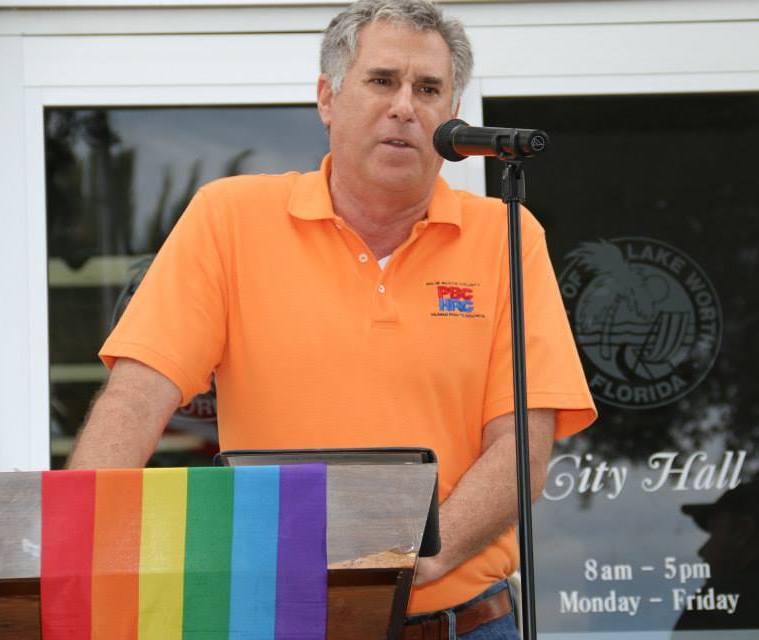
PBCHRC President and Founder Rand Hoch 

On August 11, Hoch presented a draft civil rights ordinance and urged the Village Council to enact it. By a vote of 4-1, the Council directed the Village Attorney to prepare an LGBT-inclusive civil rights ordinance for their consideration. Councilwoman Anne Gerwig cast the sole "no" vote. Having met with Hoch following the August 11 vote, Gerwig was persuaded to support the civil rights ordinance on Thursday night,
Following Thursday's vote Wellington joins Atlantic Beach, Boynton Beach, Delray Beach, Dunedin, Gainesville, Greenacres, Gulfport, Key West, Lake Worth, Leesburg, Miami, Miami Beach, Oakland Park, Orlando, St. Augustine Beach, Tampa, Venice, West Palm Beach and Wilton Manors among the cities and municipalities that have enacted LGBT-inclusive municipal civil rights ordinances.
The PBCHRC says the Town of Lake Clarke Shores will be considering an identical LGBT-inclusive civil rights ordinance at their September 15 Town Council meeting.
"Much work remains to be done in our state," added Hoch.